When Founders Need Research Before They Need More Building
A reflection on why early-stage founders often need better research before more building, and how human-centred discovery can help turn founder energy into clearer, testable decisions.
 James Giggs OgosiAugust 13, 2026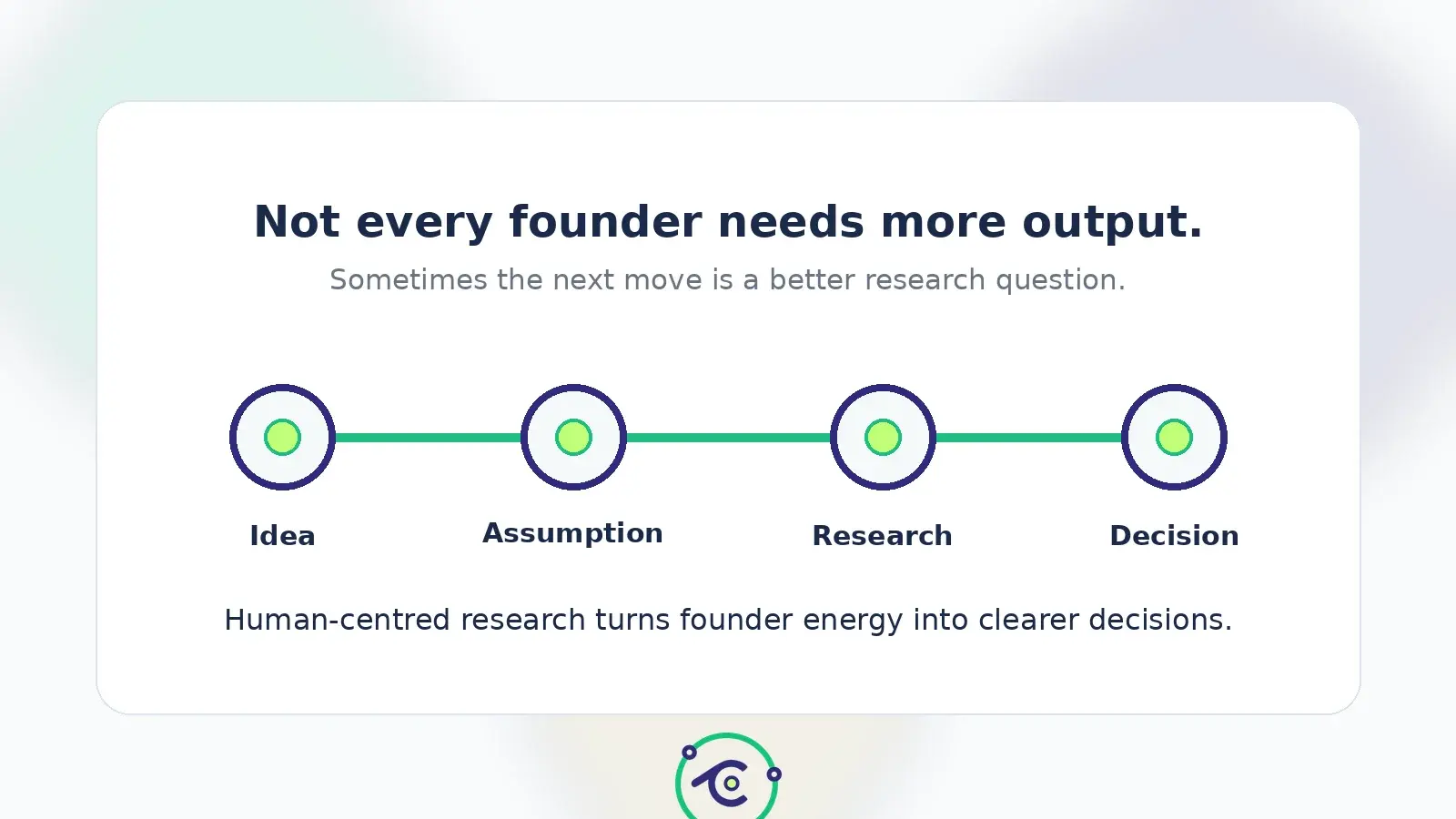
I have been thinking a lot about the point where founders move from idea to execution.
Many founders do not struggle because they lack ambition.
They struggle because the decision underneath the idea is still unclear.
The unclear decision underneath the idea
A founder can be busy and still be unclear.
They can build, launch, pitch, redesign, market or sell before they have properly understood the person they are building for.
They may have energy.
They may have a strong story.
They may even have a working product.
But if the decision beneath the work is unclear, more movement can become expensive.
The real question is often not:
What should I build next?
It is:
What decision am I trying to make before I build further?
Where human-centred design protects the founder
That is where human-centred design matters.
Not as a box to tick.
Not as a set of workshop templates.
Not as a decorative stage in a product process.
But as a way of protecting founders from committing too early to the wrong assumption.
Good human-centred work helps slow down the rush to build.
It helps founders understand who they are serving, what problem matters enough, what journey people are already living through, and what evidence is needed before the next commitment.
I think this is especially important now.
Because AI has made it easier to create faster.
But faster creation does not always mean clearer direction.
What I am building with UxAi-ClarityForge
In my own work, I am building UxAi-ClarityForge, a clarity-first studio that helps early-stage founders turn scattered ideas into structured, testable service decisions.
The work usually starts with a simple question:
What decision are we trying to make before we build further?
Sometimes that decision is about the customer.
Sometimes it is about the problem.
Sometimes it is about the journey.
Sometimes it is about whether the founder is solving a painful enough problem for the right person.
The goal is not to slow founders down for the sake of slowing them down.
The goal is to help them commit with more clarity.
What AI can structure, and what research still reveals
One thing I am learning is that AI can help structure the thinking, but it cannot replace the craft of good research.
A founder can use AI to organise assumptions.
A founder can use AI to generate interview guides.
A founder can use AI to map hypotheses and risks.
But the real learning still comes from listening carefully to people.
It comes from asking better questions.
It comes from noticing what people do, not just what they say.
It comes from knowing when an answer confirms an assumption and when an answer quietly breaks it.
That is research craft.
And it is still deeply human.
Why communities like This is HCD matter
There are founders who need access to better discovery conversations.
There are researchers, service designers and UX practitioners who know how to help teams learn without leading the witness.
There are people in this community who understand that research is not just about collecting answers.
It is about helping teams see more clearly.
For early-stage founders, that clarity can protect time, money, energy and confidence.
It can also protect customers from being handed solutions that were never properly understood in the first place.
The space between founder energy and research discipline
There is an important space between founder energy and research discipline.
That is the space I am interested in.
With UxAi-ClarityForge, I am exploring how founders can move from:
“I have an idea”
to
“I understand the decision I need to test next.”
And in some cases, the right next step will not be another feature, another pitch deck or another landing page.
It will be a small, focused piece of research.
A few discovery conversations.
A persona check.
A journey gap review.
A willingness-to-pay conversation.
A clearer view of what the founder should prove before committing more time, money and energy.
A note of thanks
I also want to acknowledge Gerry Scullion, whose generosity with time and feedback has helped me think more clearly about this work.
Over a few conversations, his questions and reflections have helped me sharpen how I describe UxAi-ClarityForge and the role it can play in helping founders make better decisions before they build.
That kind of practitioner feedback matters, especially when something is still taking shape.
Why I am sharing this here
I am still shaping this work carefully.
But I wanted to share it here because this community feels like the right place to think openly about the relationship between founder clarity and human-centred research.
I would be glad to connect with researchers, UX practitioners and service designers who care about helping founders make better decisions before they build.
Not to rush into anything.
Just to learn, exchange perspectives and understand where our work may naturally overlap.
For me, the principle is simple:
Clarity before commitment.
Because when the decision is unclear, more building can become very expensive.
And sometimes the most useful thing a founder can do is not to build the next thing.
It is to understand the next decision.